
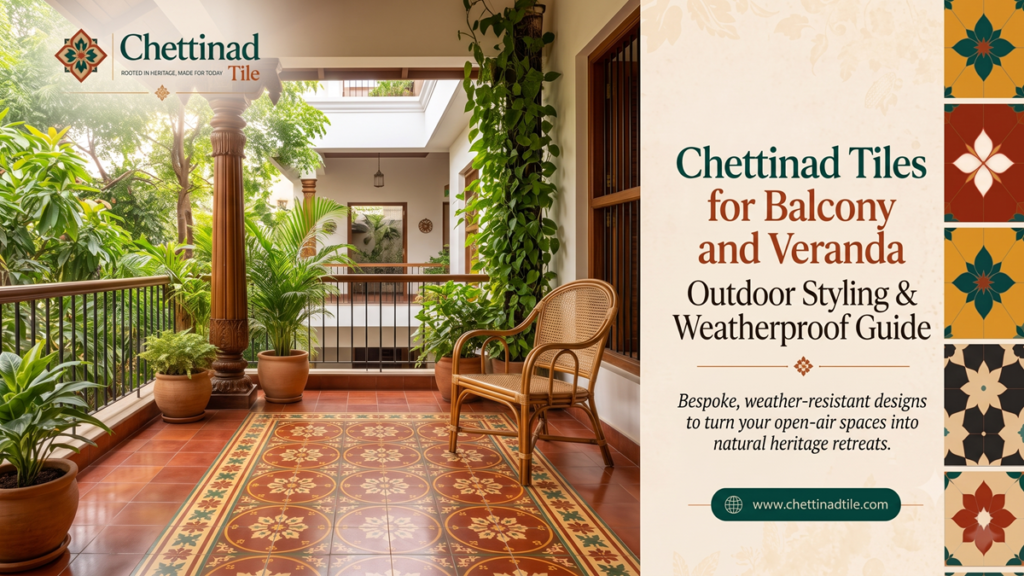
Using Chettinad tiles for balcony and veranda spaces is redefining how contemporary homeowners transform their outdoor perimeters into tranquil living retreats. In high-density apartment blocks and modern suburban bungalows alike, balconies often turn into neglected utility ledges or barren expanses of cold, factory-extruded ceramic slabs. Hand-pressed Chettinad tiles for balcony floors infuse natural warmth, tactile comfort, and timeless South Indian architectural heritage into these open-air thresholds.
Whether you are crafting an urban balcony garden oasis, designing an open-concept penthouse terrace, or restoring an ancestral villa portico, understanding how handcrafted surfaces handle ambient weathering is essential. Hand-pressed using mineral pigments, fine river sand, and cement, authentic Chettinad tiles for outdoor living create an inviting transitional zone between your interior sanctuary and nature.
This comprehensive outdoor guide breaks down material behaviour under UV rays and rain, four distinctive balcony design layouts, drainage essentials, and routine care routines to help you design a weatherproof, long-lasting veranda.
Can Handcrafted Cement Tiles Handle Sun, Rain, and Tropical Weather?
A common question among homeowners is whether artisanal, sun-cured tiles can survive continuous sun exposure and torrential monsoon rains. Addressing this requires looking closely at how authentic cement tiles are made compared to mass-produced glazed alternatives.
Unlike glazed ceramic or vitrified flooring, where synthetic print patterns sit beneath a thin glass top-coat that can chip or bleach under UV rays, authentic Chettinad tiles for balcony areas feature a solid 3 mm to 4 mm decorative wear layer.
Artisans formulate this face layer with high-grade natural iron oxide earth pigments hydraulically pressed directly into a concrete matrix. Because these mineral pigments are naturally UV-stable rather than artificial surface dyes, your Chettinad tiles for balcony environments resist sun bleaching and remain vivid over decades of outdoor exposure.
During production, the tiles undergo prolonged immersion in water tanks. This gentle concrete water-curing process allows the cement to hydrate fully and cure without kiln firing, giving the finished tile high structural density.
Untreated cement is naturally microporous and will absorb rainwater if left unprotected, potentially causing temporary darkening or efflorescence. However, when sealed with a breathable, penetrating sealer, the microscopic pores close. The surface sheds water seamlessly, enabling these handcrafted slabs to perform as resilient, weatherproof cement tiles that stay structurally sound across seasons.
4 Inspiring Balcony & Veranda Styling Ideas
Transforming an outdoor space requires balancing proportion, greenery, outdoor furniture, and floor patterns. Here are four creative ways to install Chettinad tiles for balcony and veranda layouts.
1. The “Green Oasis” Balcony Garden
Compact apartment balconies come to life when paired with lush foliage. Layer traditional floral or botanical Chettinad patterns across the floor to establish a grounded, garden-style base. Frame the flooring with terracotta planters, trailing pothos, and vertical bamboo trellises. Choosing rich emerald greens, mustard yellows, and earthy terracotta shades complements natural leaves and turns an ordinary high-rise balcony into an earthy urban sanctuary.
2. The Traditional Villa Veranda (Thinnai)
In classical South Indian architecture, the thinnai—a raised, pillared veranda along the front entrance—serves as a welcoming social gathering spot. You can replicate this timeless look in independent houses and duplexes by pairing solid neutral cement tiles with an ornate floral running border (kodi). Complement the layout with turned wooden or stone pillars, cane armchairs, and brass planters to build a shaded sit-out steeped in heritage charm.
3. The Minimalist Sunset Tea Alcove
For modern penthouses with wide-open terraces, opt for clean geometric patterns in dual-tone palettes like charcoal and off-white or deep oxblood and ivory. A crisp geometric pattern establishes an uncluttered, modern floor plane that catches warm evening light. Add a low teak bench and a hammered metal coffee table to turn the corner into a relaxing spot for morning coffee or sunset reading.
4. The Framed “Outdoor Carpet” Runner
In long, narrow apartment balconies, laying patterned tiles edge-to-edge can occasionally feel visually busy. Instead, install a central runner of intricate geometric tiles flanked by 4-to-6-inch margins of flamed granite, rough Kota stone, or river pebbles. This “tile rug” effect draws the eye outward toward the open view while visually lengthening narrow outdoor dimensions.
Slip Resistance & Barefoot Comfort of Chettinad Tiles for Balcony Floors
Balconies and open verandas naturally experience rain, watering runoff from potted plants, and direct summer sun. Installing authentic Chettinad tiles for balcony settings ensures both underfoot safety and thermal comfort:
- Superior Wet Slip Resistance: Polished vitrified and glazed tiles present a severe slipping hazard as soon as water touches their slick surface. In contrast, Chettinad tiles for balcony applications are cast flat against plate glass, giving them a smooth, unglazed, micro-textured matte finish. This provides steady barefoot traction even during heavy monsoon showers, making them exceptionally safe for children and elders.
- Natural Thermal Cooling: Machine-made vitrified ceramic slabs trap ambient heat, making outdoor floors uncomfortably hot to walk on under peak summer sun. Natural sand-and-cement composites breathe and dissipate heat efficiently. Even during hot afternoons, authentic cement flooring stays pleasantly cool to the touch.
- Sturdy Base for Planters: Authentic cement tiles hold up well under heavy terracotta planters, ceramic pots, and wrought-iron furniture without scratching or cracking under distributed weight.
Surface Comparison: Outdoor Flooring Materials
| Feature / Metric | Authentic Chettinad Cement Tiles | Standard Glazed Vitrified Tiles | Exterior Natural Sandstone / Kota |
| Surface Grip Under Rain | High (Micro-textured matte finish) | Poor (Slick surface when wet) | High to Moderate (Naturally textured) |
| Barefoot Temperature | Naturally cool under tropical sun | High heat absorption (Hot to walk on) | Moderately cool to warm |
| UV Resistance | Mineral oxides resist sun bleaching | Printed ink layers can fade | High (Natural stone stability) |
| Aesthetic Depth | Handcrafted artisanal character | Factory-printed, repetitive motifs | Natural earthy veining / Plain slabs |
| Maintenance Need | Periodic penetrating sealer | Low maintenance (Acid-safe) | Occasional sealing & algae washing |
Critical Installation & Drainage Rules for Outdoor Areas
Proper subfloor preparation is essential when installing handmade tiles in outdoor and semi-outdoor zones. Follow these installation fundamentals to prevent pooling water and moisture issues:
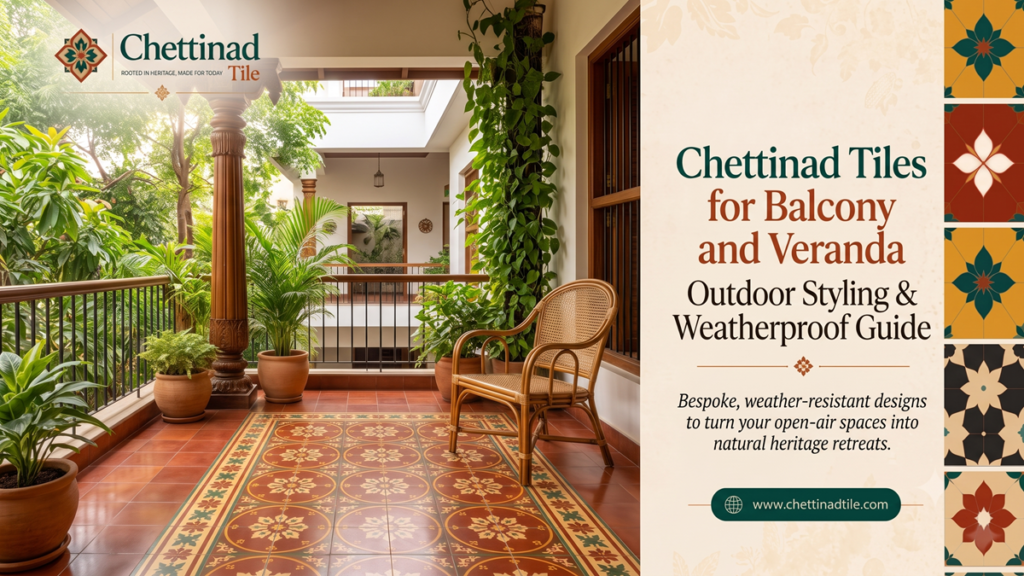
- Ensure a 1:50 Surface Slope: Outdoor terraces and balconies must never allow rainwater to pool. According to standard exterior drainage slope guidelines, slope the screed base at a minimum 1:50 to 1:60 gradient toward the balcony drain outlets. Always confirm that water flows freely toward the drain before laying Chettinad tiles for balcony projects.
- Apply an Elastomeric Waterproofing Barrier: Apply a certified exterior waterproofing membrane across the structural balcony slab, extending it 4 inches upward along the skirting wall junctions before pouring the mortar bed.
- Set on Polymer-Modified Mortar: Bed tiles into a polymer-modified exterior tile adhesive rather than a lean sand bed. This guarantees a firm bond and stops moisture from wicking upward into the tile base.
- Keep Joints Hairline Tight: Install tiles with tight 1 mm to 1.5 mm hairline joints. Fill the joints with water-resistant exterior grout or matching cement slurry, cleaning residue off the surface immediately to prevent grout haze.
- Apply an Impregnating Outdoor Sealer: After the floor and grout have cured and dried thoroughly (typically 48 to 72 hours), apply two uniform coats of a UV-stable, penetrating outdoor stone sealer. Avoid shiny topical acrylic coats that can peel under sunlight; penetrating impregnators sink deep into the pores, keeping the tile breathable while repelling water.
Outdoor Cleaning & Long-Term Care Routine
Maintaining the vibrant finish of your balcony and veranda tiles is simple and requires only gentle, non-corrosive care:
- Sweep Off Dust and Leaves Regularly: Organic debris like fallen leaves and wet flower petals contain natural tannins that can leave light surface marks if left to decompose on damp floors. Sweep your balcony regularly with a soft-bristle broom.
- Clean with Mild, pH-Neutral Soaps: Mop the floor using clean water and a mild, pH-neutral soap or organic liquid floor cleaner. Never use acidic toilet cleaners, vinegar, or harsh bleach, as acid chemically reacts with the cement matrix and etches the finish.
- Use Saucers Under Heavy Planters: Place terracotta or rubber-padded drip saucers beneath plant containers to prevent soil runoff, stagnant drainage water, and mineral rings from collecting under pots.
- Reapply Outdoor Sealer Every 2–3 Years: Because balconies face direct sunlight and seasonal weather changes, reapply a breathable penetrating sealer every 24 to 36 months to maintain strong water repellency.
Frequently Asked Questions About Chettinad Tiles for Balcony Spaces
Can Chettinad tiles for balcony floors be installed on an uncovered, open-to-sky terrace?
Yes, provided the balcony substrate features proper drainage slopes and an elastomeric waterproofing membrane beneath the tiles. Applying a high-grade, breathable penetrating sealer protects your Chettinad tiles for balcony use against continuous monsoon rains while allowing sub-base moisture to evaporate naturally.
Will intense summer sunlight cause the tile colours to fade?
No. Authentic Chettinad tiles are colored with natural mineral oxides pressed into the top 3 mm to 4 mm wear layer, rather than surface-printed dyes. These mineral pigments are inherently UV-stable and maintain their rich depth even under continuous sun exposure.
Can I wash my outdoor balcony tiles with a high-pressure jet spray?
Light pressure washing is safe for periodic outdoor cleaning. However, use a wide-fan nozzle kept at least 12 inches away from the tile face, and avoid concentrating the high-pressure stream directly on the hairline grout lines.
Are handmade tiles heavy for modern apartment balconies?
At approximately 18 mm to 22 mm in thickness, hand-pressed cement tiles have a weight profile comparable to natural granite or thick marble slabs. Standard residential apartment balconies engineered to local structural codes easily accommodate them when laid with thin-bed polymer adhesive.