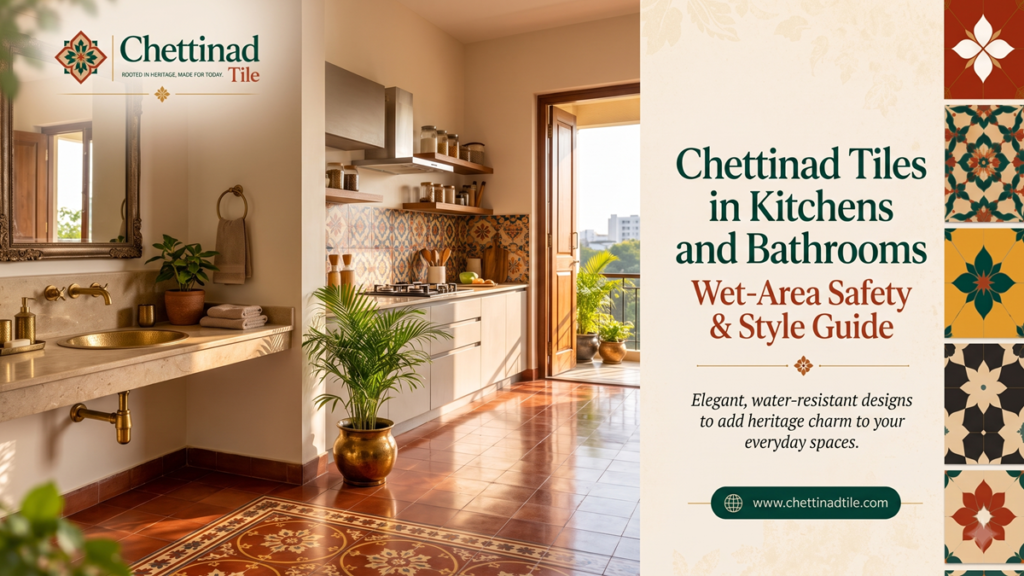
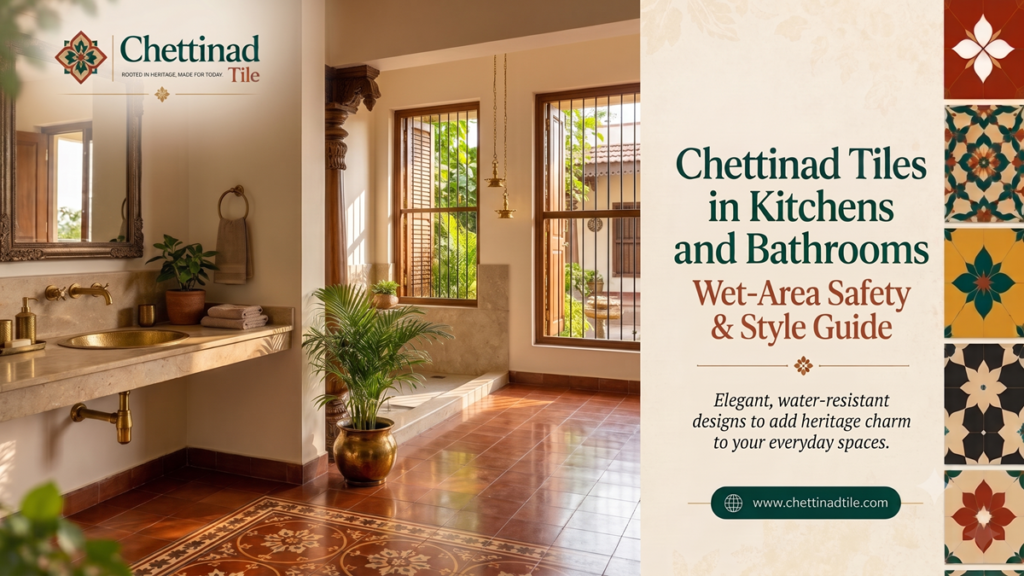
Using Chettinad tiles in kitchens and bathrooms is redefining how modern Indian homes celebrate personal space. Once treated as isolated cubicles hidden behind doors, the kitchen and bathroom are now extremely expressive parts of the house. Today’s kitchen is the hub of the home and the entertainment room, while the bath is the spa you use every day.
However, while homeowners and interior designers aim to bring long-lasting warmth and individual character to these environments, they are met with a slew of impersonal choices. Factory-printed ceramic slabs and icy vitrified panels often strip these spaces of personality. Handcrafted heritage tiles, however, give rooms mineral richness, a touch of warmth and a distinct sense of identity.
Bring a piece of history and our artisans’ craft into your everyday with genuine Chettinad tiles for the kitchen. These hand-pressed cement floors have origins in the ancient havelis and palace-dwellings of the Sivaganga region in Tamil Nadu and infuse the most utilitarian spaces in your home with a unique and vibrant visual texture.
But when you add cement tiles in wet areas to more humid and semi-humid spaces, things are a little less certain. Will you get water rings from handmade tile? Will it be too slick on your feet? Did the frying oil hit the ceiling?
This all-inclusive style and technical reference guide tackles the material science, water-cure endurance, wet-area layout principles and maintenance procedures you need to be assured, to be able to set up Chettinad tiles throughout your kitchen and bath.
“…have origins in the ancient havelis and palace-dwellings of the Sivaganga district in Tamil Nadu…”
The Material Science: How Handcrafted Cement Performs in Wet Areas
Some homeowners believe that the durability of handmade tiles will not work well in areas that experience running water, sticky situations, as well as instant blow-overs. How are Chettinad Tiles made?
A genuine Chettinad tile does not feature a printed glazed clay lining as it does with machine-produced ceramic or porcelain.
Instead, the decorative layer is part of the tile’s cast-iron composite material – an unbaked, hydraulically pressed composite. Composed of dense particle-sized local river sand, white cement and imported natural mineral oxides, it has a 3 mm to 4 mm integrated layer of decorative wear cast directly onto the dense concrete bed.
As the tile is cured in oxygenated water tanks for over a week, the cement is slowly, naturally hydrated, which results in a structural body of the tile that will not warp, craze or crack with moisture exposure.
While cement is as naturally porous and breathable as any other natural cement stone, in dry zones it breathes just fine at ambient room temperature, and in wet zones it can absorb moisture and cause real water staining if not sealed with a breathable impregnator.
When sealed with a breathable, penetrating impregnator, they function as resilient, waterproof heritage tiles because the tiny capillaries on the surface of the cement close up, leaving water beading on the surface.
In addition, factory-glazed vitrified tiles turn slippery when wet on the feet, but due to the textured surface, skin can grip even when the shoe is wet. This makes genuine Chettinad bathroom flooring in dry zones a much safer and more comfortable choice than the shiny polished finish of machine-pressed tiles.
Because the tile is cured through slow hydration in water tanks rather than baked with chemical glazes, installing Chettinad tiles in kitchens and bathrooms ensures an enduring, breathable floor that naturally resists thermal shock
“…slowly hydrated through natural water curing techniques, producing a resilient cement composite body…”
Designing the Culinary Space: Kitchen Backsplashes & Floors
The kitchen is the home’s visual and emotional hub – the heat, cooking fumes, oil splatter, food prep. Chettinad design sets a striking contrast to contemporary cabinetry in this lively kitchen.
1. The Statement Stove Backsplash
Directly behind a gas range or induction cooktop, the wall section can be used as a canvas for rich floral and geometric patterns. Because this can be a dry, vertical surface that isn’t walked upon, this delicate, multichromatic tile mosaic has room to breathe.
A grid of 8×8 kitchen backsplash tiles in earth tones—oxblood, mustard yellow, and forest green—creates a mosaic tile mural to complement minimal acrylic or fluted teak cabinetry. And since turmeric vapours and mustard-seed oil splashes can’t be avoided when cooking, a food-safe, oil- and heat-resistant penetrating sealer was also applied to the backsplash, making it impervious to wipe-down.
2. Framing Kitchen Islands and Breakfast Bars
The boundaries of space are often unclear in open-plan kitchens, between food prep and tablespaces. Using decorative Chettinad Tiles in Kitchens and Bathrooms along the face of a kitchen island, worktop, or bar stool alcove provides a lively visual divider without splitting your floor plan.
3. Entire Kitchen Floor Mats
In the galley kitchen, a passage between rows of cupboards gets a great deal of dimension and depth when the screen is a step or two wider at each end, with checks inspired by Chettinad geometric designs. The sunbaked colours withstand dropped spoons and constant footfall.
Transforming the Bath: Luxury Powder Rooms & Dry Zones
Bathrooms inherently have two areas of functionality: the wet zone (shower, with its tools and water, constantly pouring) and the dry zone (pencil, book, water basin, mirror, sink, water closet). Recognising this balance is important when utilising handmade tiles.
1. The Powder Room Showstopper
A guest half-bath or powder room. Since it lacks a shower stall, this is the best candidate for a fully continuous heritage floor. The humidity will be extremely low and the bare-foot traffic virtually nonexistent, so fill this space in deep terracotta, cobalt blue, or colourful kolam designs.
Without the requirement of industrial-grade sealers that would lock out water. Decorate the space with a floating brass basin, vintage mirror frames, and ambient pendant lighting for a boutique-hotel sort of getaway.
2. The Vanity Accent “Tile Rug”
Design a stunning master bath by anchoring a complex chettinad “tile rug” immediately before the sink and vanity mirror counter. Build a framed border around a central core of flowering tiles within the zone, and maintain the area outside the core using neutral tones of granite, natural slate, or low chroma terrazzo. This setup makes the vanity a luxury wardrobe area and not the primary shower location.
3. Accent Wall Niche & Mirror Borders
For homeowners planning Chettinad Tiles in Kitchens and Bathrooms, shifting intricate motifs onto vertical walls and recessed niches creates a refined look without heavy floor exposure Use a pattern of handmade border tiles in front of a recessed washbasin niche, splash zone, or behind a vanity counter. Bring colour to hydro-slipped niches with mineral oxides-note the intense colour against plain white plaster or micro-cement walls.
5 Ways to Style Chettinad Tiles in Kitchens and Bathrooms
No two homes are the same. Here are five handcrafted Chettinad Tile design layouts that we have field-tested for you to incorporate the inimitable Chettinad Tile into your modern home’s kitchen and washrooms:
Concept 1 – The “Perimeter Frame” Vanity Floor
Best suited for: Small master bathrooms and ensuite powder rooms.
Flooring: Install full off-white, light grey, or subtle ivory flooring with a real running floral border (kodi) on the entire centre floor area of the space, leaving 4 inches down from the skirting walls. It adds a feeling of custom tailoring to the space as a backdrop for the washroom’s plumbing fixtures, mirrors and cabinetry to sit proudly on.
Concept 2 – The Seamless Open-Kitchen Runner
Ideal for: Parallel kitchens which are L-shaped, with the sides opening out into the dining area.
Place a double row, centre-interlocked band of geometric tiles along the main prep aisle in the kitchen aisle between the counters. Flank your runner with simple dark granite or neutral stone margins that match the counter material, giving you a hard-wearing carpet runner appearance.
Concept 3 – The Half-Wall Dado with Brass Bead Transition
Most appropriate for: Dry bathrooms, main toilet rooms, and formal dry vanity areas.
This project used Chettinad tiles in a vertical run starting at floor level to 4′ (Chair-rail height or dado). Use a 10 mm polished brass trim or a bullnose terracotta bead to start the flush-finished run to the ceiling on your main vanity wall with breathable lime plaster or mineral water-resistant paint.
Concept 4 – The Checkerboard Alcove & Recessed Niche
Ideal for: Bathroom or toilet alcoves with no doors or covers. Open pantry walls and kitchen coffee bars.
Opt for 6″ x 6″ solid mustard-yellow and deep oxblood-red cement tile for recessed wall niches. A timeless two-tone checkerboard, the mustard and oxblood shade combo helps define the room’s heritage warmth and avoid the visual clutter of small spaces.
Concept 5 – The Integrated Threshold Transition
Perfect For: Entry doors leading to kitchens or powder rooms.
In classic South Indian house design, the vaapadi (threshold beam) divides the living areas. Down the middle of the doorway threshold, install one row of paisley border tiles (Manga) underneath a teakwood frame to use as a simple and stylish doorway crossover.
Pattern & Placement Matrix: Wet and Semi-Wet Zones
Selecting the ideal tile pattern involves balancing surface safety, room dimensions, splash exposure, and cabinetry finishes:
| Zone / Application | Recommended Motif | Primary Function | Moisture / Spill Exposure | Ideal Pairing Accents |
| Kitchen Cooktop Backsplash | Ornate Floral or Geometric Grids | Visual focal point & wall shield | High heat, steam, oil and sauce splatters | Fluted teak joinery, brushed brass pot fillers |
| Kitchen Island Facade | Interlocking Geometric Medallions | Architectural room divider | Occasional shoe scuffs, dry spills | Quartz worktops, wrought iron counter stools |
| Powder Room Floor | Complete Kolam or Symmetrical Field Tiles | Ambient warmth & statement floor | Low moisture, occasional water drops | Hammered copper sinks, unlacquered brass taps |
| Vanity Dry Floor Zone | Framed “Tile Rug” with Floral Borders | Tactile warmth & non-slip step | Moderate splashes from sink and basin | Floating oak vanities, linen hand towels |
| Bathroom Accent Niches | Petite Paisley (Manga) or Running Leaf | Decorative recess detailing | Steam, shampoo and soap splashes | Micro-cement walls, matte black fixtures |
Frequently Asked Questions
Is it okay to put Chettinad tiles in a walk-in shower?
When installing authentic Chettinad Tiles in Kitchens and Bathrooms, we advise keeping handmade cement pieces within dry zones and vanity perimeters rather than directly inside high-saturation shower stalls.
Are Chettinad tiles slippery when wet?
No. With a natural cement base, set and poured on plate glass, with natural cement and fine river sand, treated cement tiles have a smooth surface that is soft but with micro texture, matte, not high gloss. While vitrified high-gloss tiles are very slippery when wet, treated cement tiles are grip-worthy for barefoot walking.
How frequently should I re-seal my bathroom and kitchen tiles?
Kitchen Backsplashes and Bathroom Floors: Reapply a professional penetrating impregnator every 18-24 months. Simply test it with a quick water-drop test: place a few drops of water on the tile, and if they bead up nicely on the surface, then your seal is good to go. If you see the water darken the tile within 60 seconds, then it’s time to reapply.
Is it suitable to install Chettinad tiles over underfloor heating or to cover existing tiles in the bathroom?
Yes. The hard-pressed cement tiles are highly resistant to temperature changes, so they are suitable to be laid over underfloor heating.