
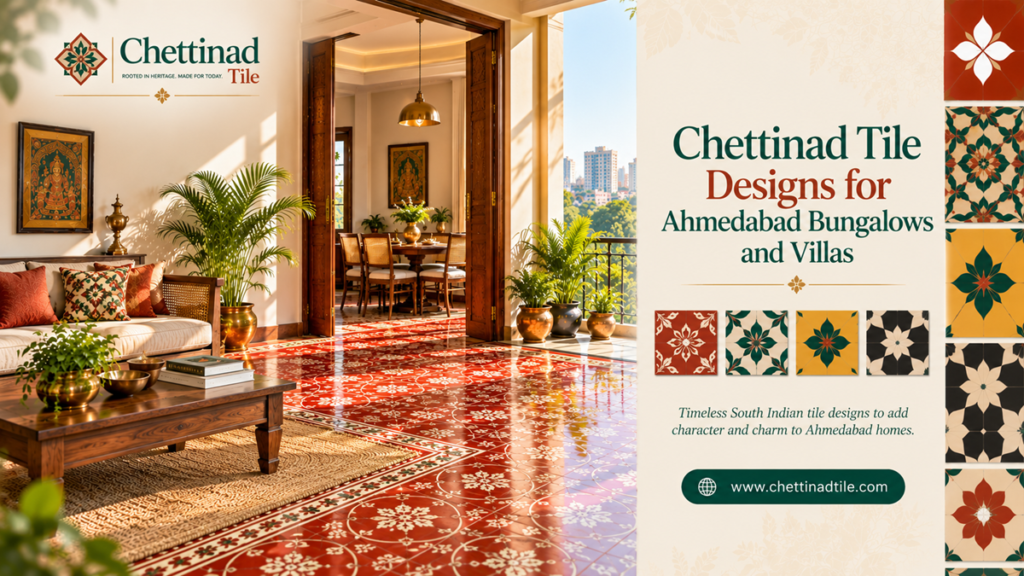
Ahmedabad is home to a wide range of architectural styles, from traditional Gujarati houses to spacious bungalows and modern luxury villas. As homeowners look for distinctive ways to design their interiors, flooring has become an important part of creating a comfortable and visually appealing living space. Chettinad tile designs for Ahmedabad bungalows and villas offer an opportunity to bring traditional Indian craftsmanship, decorative patterns, and vibrant colours into modern residential architecture.
Inspired by the history of Chettinad in Tamil Nadu, these tiles are famous for their look and traditional style. Depending on the collection you have, they can fit well in living rooms, entryways, dining areas, courtyards, and other special parts of a house. Their nice designs can bring character to a room without needing a lot of decoration.
Picking tiles is not just about choosing a pretty design. People who own homes should think about the size of each room, the light, the furniture, the colors that go together, how easy they are to clean, and the conditions for installing them. Whether you are building a house or fixing up an old one, choosing tiles carefully can help create a style inside that mixes old ideas with modern life.
1. Why Choose Chettinad Tiles for Ahmedabad Bungalows and Villas?
Chettinad tiles give people a choice when they want their flooring to improve the look of their house. Instead of seeing the floor as just a basic part of the room, decorative tiles can create a design style that goes with the furniture, the wall colors, the lights, and the building details. The designs can work well in old-style homes as well as new homes if they are selected according to the interior style.
One of the reasons people enjoy Handmade Chettinad tiles is because of their fashionable look. Classic patterns and selected color groups can make a front door area or a living room feel more special. Homeowners can choose designs for areas where they want to make a statement or go for quiet designs for spaces where they want a simpler feel.
These tiles can also be used in different types of interior plans. In a home with a style, tiled floors can match furniture, old-fashioned decorations, and soft lights. In a house, a pattern that is geometric or gentle can add something without ruining the clean look of the space.
The best design depends on the tile. It depends on how it will be used and what the room requires. Before buying, check the size of the tile, the surface, how it is installed, and how to take care of it with the seller. With the right preparation, Chettinad tiles can become a part of the design that showcases the homeowners’ style and complements the building.
2. Best Chettinad Tile Designs for Modern Villas and Traditional Bungalows
Selecting a tile design should start with the style and the feel that the home should have. A traditional bungalow can work well with floral patterns and colors that reflect history. A modern villa might look better with shapes or a more limited range of colors. The goal is to pick a design that goes well with the room, without fighting with everything else.
A contemporary villa décor may look far better with simple geometrical patterns and colours that are more restrained.
Floral Chettinad tile designs can add a charming and inviting look at the entrance of your home or in your favourite living-room corner or classic dining nook. These pattern designs might suit neutral walls, with less emphasis on colour and more focus on finished natural wood. For owners who want the look of a balanced home, some geometric Chettinad tiles might be a great choice for the hallway or for a modern house.
Multicolour patterns often make the best statement in a large room but may need to be underdone by simpler furnishings and wall coverings. For a more compact space, opt for patterns scaled to the size of the floor. A sample grid will show you what the pattern will look like over the space of several tiles.
It can be helpful to think of the flooring design in terms of how visible it is likely to be. An intricate design might work best at the front door where it’s immediately visible, while a more modest design may be appropriate if it will be accompanied by brightly coloured furniture or wall treatments.
Explore the Chettinad tiles in Ahmedabad page to learn more about options relevant to your project. Compare available designs and confirm product specifications before making a final decision.
3. Room-Wise Chettinad Tile Ideas for Ahmedabad Homes
Functionality Each room has a different function, therefore, you might not want to have a fantastic tile design in one room but not in another. Room-by-room planning of your floor is practical for the user, as it allows consistency in each room but still functions within the area. Factors such as furniture, size, traffic, cleaning, and connecting rooms are all taken into consideration.
Using the Chettinad living room tile design will make it the highlight of the room and will add charm to the room. If it is a large living room, you can go for a more ornate design, but if it is small, then a border or a slightly simpler design is adequate. Minimize the contrast with the colours of the walls and the furniture.
Entryways or foyers are a space for a bold design because the design determines the whole house’s interior design style.
A confined style region may give the entry a rich look without the need for the look in each room. A picked patterned area can add to the surrounding development to the entry within the patio, or kitchen area, without the need for a ready-made pattern. For dinner time, choose a pattern that is one of a kind, chairs are not hard to wash and can disguise food splatters.
You need to be even more careful in courtyards and semi-open spaces. Before you install tiles in these spaces, ensure they are suitable for damp conditions, exposure to sunlight, and extremes of temperature. You also need to make sure that the surface can withstand the amount of foot traffic you will have and that it is slip-resistant.
Brightening hallways can be accomplished with pattern repeats or understated borders providing a visual connection between adjacent rooms. For specific finishes, ensure the product can be hung on the wall, and fittings fit.
If the homeowners choose each room by function, then they can get the design by using the same pattern for the whole house.
4. Colour Combinations That Complement Ahmedabad Interiors
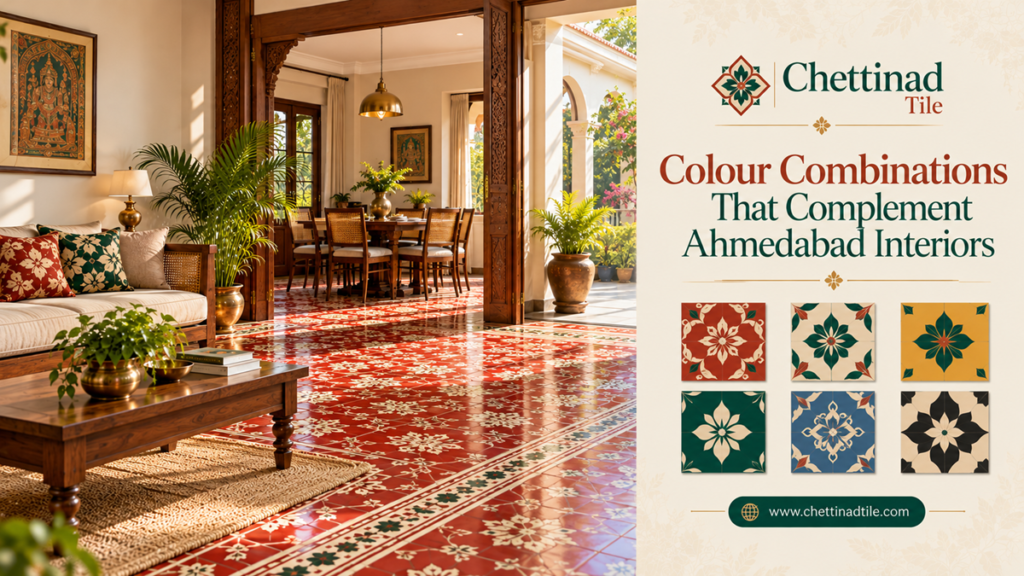
Colour selection plays an important role in how a room feels. The right combination can make an interior appear warm, bright, traditional, contemporary, or visually dramatic. When selecting Chettinad tile colour combinations, consider the wall paint, furniture, natural light, and finishes already planned for the home.
A warmer classic mix of Terracotta and Cream would go well with furniture and neutral tones. It could work nicely in a bungalow at the door or in the dining room. Blue and white: A blue and white colour scheme has a look that might work well in a room that is brightly lit and contains relatively uncomplicated furniture. Green and beige together give a natural look which blends nicely with plants, wood and the rest of our neutral surfaces. More contrast between black and cream means they are perhaps better suited for a ‘feature area’ rather than covering a whole room. In villas, grey and off-white are much more subtle and allow the feature tile to stand out.
Lighting can change how these colours appear. A tile that looks soft and neutral in a photograph may appear more vibrant under direct sunlight or warm artificial lighting. Review samples alongside the actual wall paint and furniture materials whenever possible.
Don’t use lots of different patterns in one room. If you have a patterned floor, use plain curtains, simpler furnishings and less ‘busy’ wall pictures. If you have busy furniture or wallpaper with a pattern, you could try a simpler tiled pattern.
The intent is not to be uniform all across. Select colors that will complement each other, such as base tones, so that the floor, walls, and furniture will match. With the many potential combinations of these three colors, you can easily coordinate the older tile pattern to be aesthetically appreciated in fashion and modern homes in Ahmedabad.
5. How to Combine Traditional Chettinad Tiles with Modern Interior Design
Traditional-inspired flooring is a perfect match for modern homes, as long as it has a firm design scheme. Minimalist furnishings, neutral-colored walls and decluttered surfaces, as well as open layouts, dominate modern interior design. Well-chosen ornamental tiles bring personality and substance to contemporary interiors without creating a crowded appearance.
A reasonable solution is to add patterned flooring to an area of your choice. A decorated entrance to your home, a focused dining zone, or a feature zone in a large living room can generate sufficient visual interest without having to implement the same pattern all across your house.
Material combination matters too. For warm colours, wooden furniture can fit well, while for more modern designs, details in glass and metal are more appropriate. Natural textures, plants and simple lighting will help to balance a bold floor design. The right combination will also have to take into account the real colours of the tiles.
Yet another issue: motif scale. Detailed large-scale motifs can be stunning in a generous room, but might be overwhelming in a small space. Very small, fine work or more modest geometric patterns are easier to use in tight modern arrangements.
Set lighting to show the floor and avoid too much contrast. Look at samples in daylight and the room lighting. If you have contrasting flooring in adjoining rooms, look at transitions, colour relationships and the direction of the pattern.
‘Traditional feels fresh when balanced with space, simple materials, and a sense of restraint.
For inspiration, visit the Chettinad Tile portfolio and consider how different patterns might complement your home’s furniture, wall finishes, and architectural details.
6. Planning Chettinad Tiles for New Construction and Renovation Projects
Planning does not change whether a villa is built from scratch or whether a bungalow is renovated. When a new villa is built, the planner looks at room sizes, door widths, and even floor levels, as well as the design. During a renovation, the planner must check items.
A room‑by‑room tile plan can be made before ordering tiles. Measure each room, choose tile layout and tile size, calculate how many tiles are required, and write down any layout points for the architect, contractor, and installer to remember when matching the floor with surrounding areas.
Before tiling in a renovation, the old wall and the underlying surface below must be inspected. Ensure that the old wall is removed, repaired, levelled, ground, treated, or prepared in some way. Also consider door clearances, skirtings, stairs and junctions to rooms.
Measurements are critical when using patterned tiles. The installer may have to decide the starting position, direction, border and cuts of the tiles so that the pattern looks uniform. You may need to buy tiles if the pattern is complex and takes into account pattern directions.
Delivery planning is another part. Verify stock levels, delivery times, types of packaging, logistics, shipping, and paperwork needs for damaged materials. These must be agreed on before finalising the build schedule.
For Chettinad tiles for new homes, early coordination helps reduce last-minute decisions and makes it easier to align the tile selection with the rest of the interior. For renovation projects, careful site inspection can help identify potential installation challenges before work begins.
7. How to Estimate Tile Quantity and Budget for a Villa
Getting the number of tiles right is also part of preparing your flooring project. An estimate that is too high could mean you run out of product or have too much. Before asking for a quotation, measure the areas you will be tiling. List the areas you want to be tiled.
For a room, the surface area of the ground equals the width of the room multiplied by the length of the room. For example, if the area of the room is 15 feet long and 12 feet wide, the surface area is 15 x 12 = 180 square feet. Measure each room separately. Add up their individual requirements.
Adding an allowance for cutting, breakage, matching, and repair for the purchase quantity is a good idea. The required quantity changes depending on tile size, pattern, installation method, and design complexity. Ask the installer to provide the quantity needed before finalizing the order.
When planning the budget for tile, don’t stop at the quoted price for the tile. The total project cost might include installation labor, surface and site preparation, grout, sealants, transportation, and packaging waste disposal. Ask for a written quotation that explains the basis of the price and any extra costs.
For Chettinad tiles for villa flooring, ask whether the quotation is based on individual tiles, boxes, or square feet. Confirm how much area each box covers and whether the quoted quantity includes extra material. It is also useful to ask about batch consistency and the possibility of obtaining replacement tiles later.
Current prices and availability may vary by product and order requirements. For an Ahmedabad project, confirm the latest quotation, delivery arrangements, and expected timeline directly with the supplier rather than relying on an old online estimate.
8. Maintenance Tips and Common Mistakes to Avoid
A concrete or decorative floor that is well looked after looks good. Maintenance requirements can differ for each tile product, finish, grout, and substrate. It is always better to read the instructions that are given to you than to assume that the maintenance you do for all Chettinad tiles is the same for every tile.
Regularly. Vacuum the tile floor to remove dust and dirt. Mop the tile floor. Use the floor cleaner that the manufacturer suggests. Acid, harsh chemicals, and abrasive cleaning pads should only be used if they have been approved for use on the tile and on the grout or sealer by the manufacturers.
Wipe up any spills away, especially around places where you eat or keep food and drinks. Check the grout and joints regularly. Think about re‑grouting the tile if the grout starts to crack. If you need to seal the tile, follow the instructions on the product for the sealant and how often to re‑seal the tile.
Some other choices can work against you. Selecting a pattern that’s too busy for the room size is one example. Selecting colours from photos rather than seeing them on the wall can give you a surprise result under different light. Ordering tiles without viewing the measurements can mean you are short, and not factoring in installation can cause delays.
You also want to think about whether the tile will work in your space. There may be added requirements for slip resistance and moisture performance in wet areas. Just because the tile can work as a floor in the interior does not mean the tile will work everywhere outdoors or in a wet space.
Finally, do not overdo the tile with all design in a connected room. Use a feature, and then connect the features with colours, textures, and materials. Sometimes less is more.
9. Where to Explore Chettinad Tiles for Your Ahmedabad Home
Finding the right tiles begins with understanding your home’s style, the intended use of each room, and the type of visual effect you want to create. Before making a final selection, compare patterns, colours, dimensions, finish, maintenance needs, and installation requirements. This makes it easier to choose a design that suits the property rather than selecting a product based on appearance alone.
If you are planning a new bungalow, building a villa, or renovating an existing home, start by identifying the areas where decorative tiles can make the greatest difference. A patterned entrance, a distinctive living-room floor, or a carefully planned courtyard can create a memorable design feature while keeping the remaining interior balanced.
A well-planned tile selection should bring together appearance and practicality. By reviewing samples, confirming measurements, coordinating installation, and understanding maintenance requirements, homeowners can make more informed decisions for their Ahmedabad properties.
In conclusion, Chettinad tiles for villas in Ahmedabad offer a distinctive design direction for homeowners who appreciate traditional patterns and want to incorporate decorative character into contemporary living spaces. The most successful results come from selecting appropriate designs for each room, balancing colors with the surrounding materials, and planning the installation carefully.
“Beautiful flooring is not only about the pattern you choose; it is about how that pattern works with the space, light, and life of your home.”