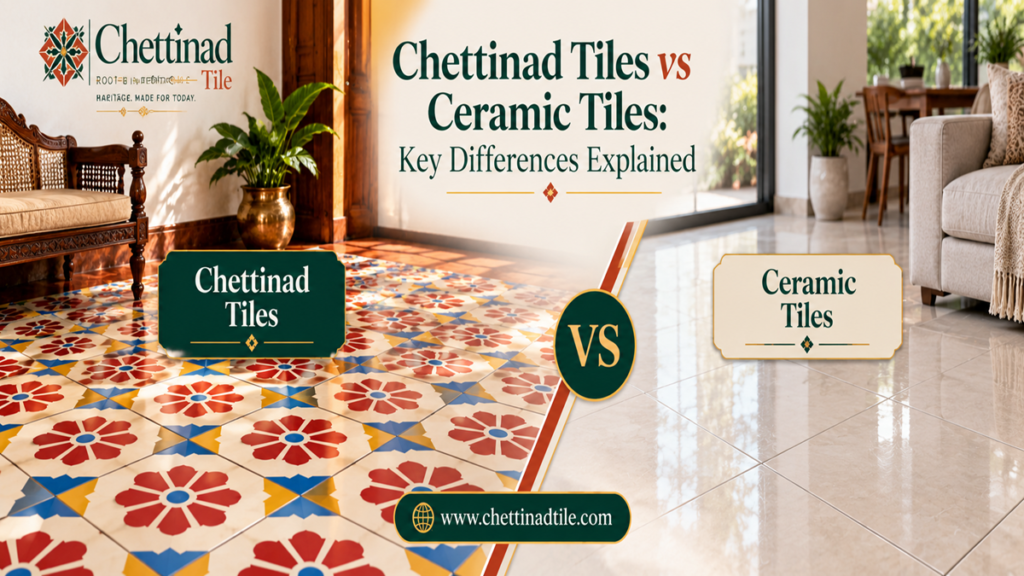
When selecting tiles for your home, a crucial factor is selecting a tile that will complement your lifestyle and home décor. Fortunately, today’s homeowners have a huge number of choices for tile for both their floors and walls, from contemporary ceramic tiles to traditional handmade tiles.
Of these options, the visual style and characteristics of Chettinad tiles and ceramic tiles are extremely contrasting. Chettinad tiles are handmade, usually have their own traditional patterns and come in vibrant colours, and are deeply rooted in Indian architectural traditions. Ceramic tiles are popular for their wide application, consistent design, affordability and wide range of designs.
But which option should you choose?
It varies based on the space, your style of decorating, how much you plan to clean, the cost of the tile and the type of tile you are looking at.
Here we are discussing the main differences between Chettinad Tiles vs Ceramic Tiles including appearance, manufacturing, pattern, usage, maintenance, installation, cost, and the best use of modern Indian homes.
What Are Chettinad Tiles?
Chettinad tiles are decorative tiles used in the architecture of the Chettinad area of Tamil Nadu, South India.
People love Chettinad style tiles for their unique shape and colour, handmade character, and traditional look. Chettinad style tiles can include geometrical patterns and borders, floral-inspired designs, and other decorative patterns depending on the manufacturer and collection.
A key appeal of theirs is how they allow you to create an interior that feels handcrafted, romantic, and rooted in heritage.
Chettinad tiles can be used in a variety of spaces, including:
- Living rooms
- Bedrooms
- Bathrooms
- Kitchens
- Entryways
- Courtyards
- Verandas
- Pooja rooms
- Feature walls
- Boutique interiors
Unlike a completely uniform surface, handmade tiles can have subtle variations in colour, texture, and appearance. For many homeowners, these variations are part of the charm of handcrafted products.
What Are Ceramic Tiles?
Ceramic tiles are manufactured tile products generally made from clay and other mineral materials that are shaped and fired at high temperatures.
They are one of the most commonly used tile categories for residential and commercial projects.
Ceramic tiles are available in a wide range of:
- Colours
- Sizes
- Shapes
- Patterns
- Textures
- Finishes
- Decorative styles
They can be used on both floors and walls, depending on the specifications of the particular product.
Modern ceramic tiles can replicate the appearance of natural materials such as marble, wood, stone, and concrete. This makes them suitable for many different interior design styles.
Chettinad Tiles vs Ceramic Tiles: Quick Comparison
| Feature | Chettinad Tiles | Ceramic Tiles |
| Design character | Traditional and handcrafted | Modern, traditional, or contemporary |
| Appearance | Artistic and decorative | Usually consistent and uniform |
| Patterns | Traditional geometric and decorative designs | Very wide variety |
| Colour options | Often heritage-inspired combinations | Extremely broad colour range |
| Manufacturing | Often associated with handmade craftsmanship | Generally industrial manufacturing |
| Design identity | Strong Indian heritage character | Highly versatile |
| Availability | May be more specialised | Generally widely available |
| Best for | Heritage and character-rich interiors | Wide range of residential and commercial spaces |
| Maintenance | Depends on product and finish | Depends on product and finish |
| Customisation | Depends on manufacturer | Usually based on available collections |
The exact characteristics can vary between manufacturers, so it is always important to check product specifications before purchasing.
1. Difference in Manufacturing Process
There is a major difference between Chettinad tiles and ceramic tiles. Chettinad tiles of traditional style may require skilled work and many manual steps. How much is dependent on the maker. Your pattern may be chosen and silk screened by artisans, and the tile prepared and finished by hand.
This handcrafted technique can produce variation between each tile.
These variations may include:
- Colour differences
- Pattern variations
- Surface texture
- Minor dimensional differences
All of these traits can make the completed concrete floor appear a lot more natural and craft-like.
Online ceramic tiles are produced through a standardized manufacturing process. Due to modern production techniques, a manufacturer’s range is predictable and consistent in size, colour and finish. This may be of great benefit if you need consistency.
2. Difference in Appearance
The visual difference is often the first thing homeowners notice.
Chettinad tiles are usually selected because the flooring or wall surface itself becomes an important part of the interior design.
A decorative Chettinad tile floor can introduce:
- Heritage character
- Traditional Indian aesthetics
- Colour
- Pattern
- Craftsmanship
- Visual warmth
Ceramic tiles offer much greater variety as a general product category.
You can find ceramic tiles designed to look like:
- Marble
- Granite
- Wood
- Cement
- Natural stone
- Fabric
- Geometric patterns
- Plain colours
Therefore, ceramic tiles can fit almost any interior style.
3. Difference in Patterns and Designs
Texture is the best feature of Chettinad Tiles. Horizontal geometric designs inspired by traditional patterns can produce an eye-catching floor immediately.
These tile patterns from Chettinad could look particularly stylish when paired with plain walls and furniture.
For instance, a moderate, neutral painted room with furniture and a tiling-style floor that is functional can strike a perfect balance of contemporary traditional influences.
There are endless design options with Ceramic tiles.
The variety of available designs includes minimalistic designs, geometric designs, floral designs, stone designs, wood designs, decorative designs, and other designs.
Hence, for a contemporary look, you would have a better chance with ceramic tiles.
Distinctively handmade Indian feel, if that is what you are seeking, Chettinad tile can offer a whole new design feel.
4. Difference in Colour
Colour plays an important role in interior design. Chettinad-style tile designs often use combinations that work well with traditional Indian architecture and natural materials.
Depending on the collection, you may find combinations involving:
- Cream
- Beige
- Brown
- Terracotta-inspired shades
- Blue
- Green
- Yellow
- Red
- Earthy tones
Ceramic tiles are available in almost every colour family. This makes them suitable for both highly colourful interiors and minimalist spaces. When selecting tile colours, consider the entire room rather than looking at the tile alone.
A strongly patterned floor can work beautifully with neutral walls, while a plain floor can allow colourful furniture and accessories to become the focal point.
5. Chettinad Tiles vs Ceramic Tiles for Living Rooms
The living room is often the main gathering space in a home, so flooring can have a major influence on its appearance. Chettinad tiles can create a strong focal point.
They can work particularly well with:
- Wooden furniture
- Cane furniture
- Neutral sofas
- Indoor plants
- Brass décor
- Indian textiles
- Natural materials
For example, a simple modern sofa combined with a decorative Chettinad floor can create an interesting contrast between traditional craftsmanship and contemporary furniture. Ceramic tiles provide more flexibility.
A homeowner can select marble-look ceramic tiles for a luxurious appearance, wood-look tiles for warmth, or plain matte tiles for a minimalist interior.
6. Chettinad Tiles vs Ceramic Tiles for Bathrooms
Bathrooms require careful consideration because they are exposed to water and moisture.
The suitability of a tile depends on the specific product and its technical characteristics.
Important factors include:
- Water absorption
- Slip resistance
- Surface finish
- Cleaning requirements
- Grout
- Installation method
Chettinad tiles can be used creatively in bathrooms when the specific product is suitable for the application.
They can be used for:
- Feature floors
- Vanity walls
- Washbasin backsplashes
- Decorative sections
- Accent walls
Ceramic tiles are also commonly used in bathrooms, with many products specifically designed for wet areas.
Always check the manufacturer’s recommendations before using any tile in a wet environment.
7. Chettinad Tiles vs Ceramic Tiles for Kitchens
The frequent spillage, splashing, moisture, and food stains in the kitchen.
Chettinad tiles for Kitchens have great potential to bring a difference in the kitchen – as a backsplash tiles or even flooring for wall accent.
A patterned backsplash can really be a talking point behind a simple countertop.
A ceramic tile is a popular kitchen choice because they come in so many varieties of styles and finishes.
For kitchen applications, consider:
- Ease of cleaning
- Surface texture
- Water exposure
- Stain resistance
- Installation quality
- Grout maintenance
The best option depends on the specific product and location.
8. Difference in Maintenance
Maintenance requirements depend on the individual tile, surface finish, installation, grout, and location. Chettinad tiles should be cleaned according to the manufacturer’s recommendations.
Basic maintenance may include:
- Regular sweeping
- Dust removal
- Gentle mopping
- Prompt cleaning of spills
- Appropriate cleaning products
- Regular grout maintenance
Ceramic tiles can also be relatively straightforward to maintain, but the cleaning routine depends on the surface.
For example, textured tiles may require more attention because dirt can collect in surface profiles. It is important to avoid assuming that one cleaning chemical is suitable for every type of tile.
9. Difference in Installation
Correct installation is essential for both Chettinad and ceramic tiles.
Before installation, the surface should be properly prepared.
Important considerations include:
- Level substrate
- Correct adhesive
- Proper tile alignment
- Appropriate spacing
- Suitable grout
- Correct cutting
- Proper curing
- Experienced workmanship
Handmade tiles may require additional attention because individual tiles can have subtle variations.
A skilled installer should understand the characteristics of the specific tile before starting the project.
10. Difference in Cost
The cost of tiles varies considerably depending on the manufacturer, design, material, size, finish, quality, location, and quantity.
Chettinad tiles may have a different pricing structure because handmade production can involve greater craftsmanship and specialised manufacturing.
Ceramic tiles are available across a very broad price range.
However, homeowners should not compare only the price per square foot.
The overall project cost can include:
- Tiles
- Transportation
- Adhesive
- Grout
- Labour
- Cutting
- Surface preparation
- Sealing, where applicable
- Maintenance
A slightly more expensive tile may still fit within a project budget if it creates the desired design and performs appropriately for the intended application.
11. Chettinad Tiles for Modern Indian Homes
Traditional tiles do not have to be limited to traditional homes. Chettinad tiles can work beautifully in modern Indian interiors when used thoughtfully.
For example:
Chettinad flooring + modern sofa + neutral walls + wooden furniture
can create a balance between heritage and contemporary design.
You can also use Chettinad tiles selectively instead of covering every surface.
Popular locations include:
- Entrance
- Living room
- Pooja room
- Kitchen backsplash
- Bathroom feature wall
- Courtyard
- Balcony
This approach allows the tile pattern to become a feature without overwhelming the entire room.
12. Chettinad Tiles for Heritage-Inspired Homes
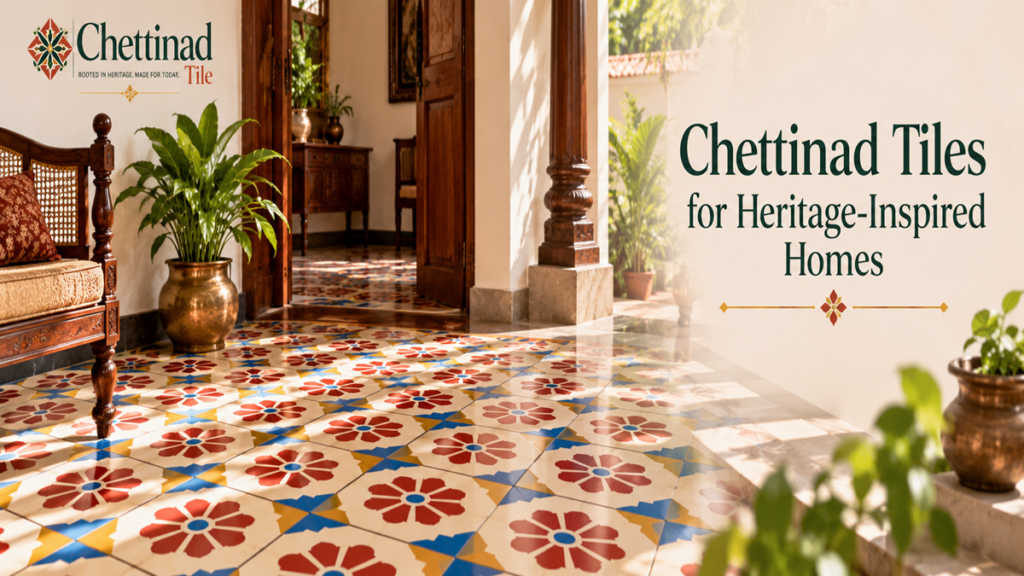
For homes inspired by traditional Indian architecture, Chettinad tiles can complement other heritage elements.
They can work with:
- Wooden doors
- Traditional furniture
- Courtyards
- Columns
- Brass décor
- Natural stone
- Handcrafted accessories
The key is creating visual balance. If the floor contains a strong pattern, simpler wall colours and furniture can help maintain harmony.
13. Ceramic Tiles for Contemporary Interiors
Ceramic tiles are particularly flexible for contemporary homes.
They can create:
- Minimalist interiors
- Industrial interiors
- Modern luxury interiors
- Scandinavian-inspired spaces
- Neutral interiors
- Natural-material-inspired interiors
Large-format ceramic tiles can provide a clean appearance, while wood-look ceramic tiles can introduce warmth.
The large variety available makes ceramic tiles suitable for homeowners who are still exploring different interior styles.
14. Which Is Better: Chettinad Tiles or Ceramic Tiles?
There is no universal answer. The better choice depends on what you want from the space.
Choose Chettinad Tiles if you want:
- Handmade character
- Traditional Indian aesthetics
- Decorative patterns
- Heritage-inspired interiors
- A distinctive flooring feature
- A handcrafted visual appearance
Consider Ceramic Tiles if you want:
- A very large design selection
- Highly consistent appearance
- Contemporary styles
- Many size options
- Easy access to standard collections
- A specific modern finish
The most important point is to choose according to the needs of your project rather than choosing based only on the name of the tile category.
15. How to Choose the Right Tile for Your Home
Before purchasing, consider the following questions.
1. Where will the tile be installed?
A living room and bathroom have different requirements.
2. What style do you want?
Do you want traditional, contemporary, minimalist, rustic, or decorative?
3. How much visual attention should the floor receive?
A patterned tile can become the centrepiece of a room.
4. How much maintenance are you comfortable with?
Understand the manufacturer’s cleaning recommendations.
5. What is your total project budget?
Include installation and associated materials.
6. What are the technical specifications?
Check the product information for the intended application.
7. Can you see a physical sample?
Whenever possible, inspect the actual tile before ordering a large quantity.
16. Common Mistakes to Avoid
Choosing only by appearance
A beautiful tile may not be suitable for every application.
Ignoring installation
Poor installation can affect the final result regardless of tile quality.
Not ordering samples
Colours can appear different under different lighting conditions.
Using too many patterns
If the floor is highly decorative, keep other elements relatively simple.
Ignoring maintenance
Understand how the tile should be cleaned before purchasing.
Comparing only tile prices
Consider the complete installation cost.
Not checking technical specifications
Always confirm that the product is appropriate for the intended location.
17. Chettinad Tiles vs Ceramic Tiles: Room-by-Room Guide
| Room | Chettinad Tiles | Ceramic Tiles |
| Living Room | Excellent for decorative flooring | Very versatile |
| Bedroom | Suitable for heritage-inspired designs | Excellent for simple and modern styles |
| Bathroom | Suitable depending on product | Widely used |
| Kitchen | Good for decorative applications | Widely used |
| Entryway | Strong visual impact | Practical and versatile |
| Pooja Room | Strong traditional character | Suitable for simple interiors |
| Courtyard | Can create heritage character | Depends on outdoor suitability |
| Commercial Space | Useful for distinctive interiors | Extremely versatile |
Again, actual suitability should always be confirmed from the manufacturer’s product specifications.
Frequently Asked Questions
Are Chettinad tiles better than ceramic tiles?
Neither category is universally better. Chettinad tiles are often selected for their handcrafted and heritage-inspired appearance, while ceramic tiles offer extensive design variety and consistent manufacturing.
Are Chettinad tiles suitable for modern homes?
Yes. Chettinad tiles can work effectively in modern homes when combined with contemporary furniture, neutral walls, modern lighting, and simple architectural elements.
Are ceramic tiles good for Indian homes?
Yes. Ceramic tiles are widely used in Indian residential interiors and are available in many designs and finishes.
Are Chettinad tiles handmade?
Traditional-style Chettinad tile production is associated with handmade craftsmanship, although manufacturing methods can vary between manufacturers. Always check the specific manufacturer’s process.
Can Chettinad tiles be used in bathrooms?
Some products may be suitable for bathroom applications, but suitability depends on the specific tile and its technical specifications. Check the manufacturer’s recommendations before installation.
Which is easier to maintain, Chettinad or ceramic tiles?
Maintenance depends on the specific tile, finish, grout, installation, and location. Ceramic tiles can be straightforward to maintain, while handmade tiles may require care according to their particular surface characteristics.
Are Chettinad tiles suitable for living rooms?
Yes. Their decorative patterns and handcrafted character can make them an attractive option for living-room floors and selected feature areas.
Do Chettinad tiles work with wooden furniture?
Yes. Wooden furniture and handmade patterned tiles can complement each other particularly well because both introduce warmth and natural character.
Can ceramic tiles look traditional?
Yes. Ceramic tiles are available in many traditional-inspired patterns and can also reproduce the appearance of natural materials.
Are Chettinad tiles expensive?
Pricing varies depending on the manufacturer, design, craftsmanship, size, quantity, and other factors. It is best to request a current quotation for the specific collection.
Final Thoughts: Chettinad Tiles vs Ceramic Tiles
The choice between Chettinad Tiles vs Ceramic Tiles ultimately comes down to the character, requirements, and design goals of your project.
Chettinad tiles can be an excellent option for homeowners who appreciate handcrafted surfaces, traditional Indian design, decorative patterns, and heritage-inspired interiors. They can turn an ordinary floor or wall into a distinctive design element.
Ceramic tiles offer a broad and flexible solution for homeowners looking for extensive design choices, consistent appearance, and products suitable for a wide range of residential and commercial applications.
Neither option needs to be viewed simply as a replacement for the other.
In fact, both can be used creatively within modern Indian architecture.
A home might use decorative Chettinad tiles in the entrance or living room while using ceramic tiles in bathrooms and utility areas. Another project may use Chettinad tiles as a kitchen backsplash or feature wall while keeping the rest of the interior minimal.
The best approach is to consider the design, location, technical requirements, maintenance, installation, and overall budget before making a final decision.
If you are looking for a tile that adds traditional craftsmanship and visual character to your home, exploring handmade Chettinad tile designs can be a worthwhile starting point.
Choose the tile that not only covers your surface but also complements the story and character you want your space to express.